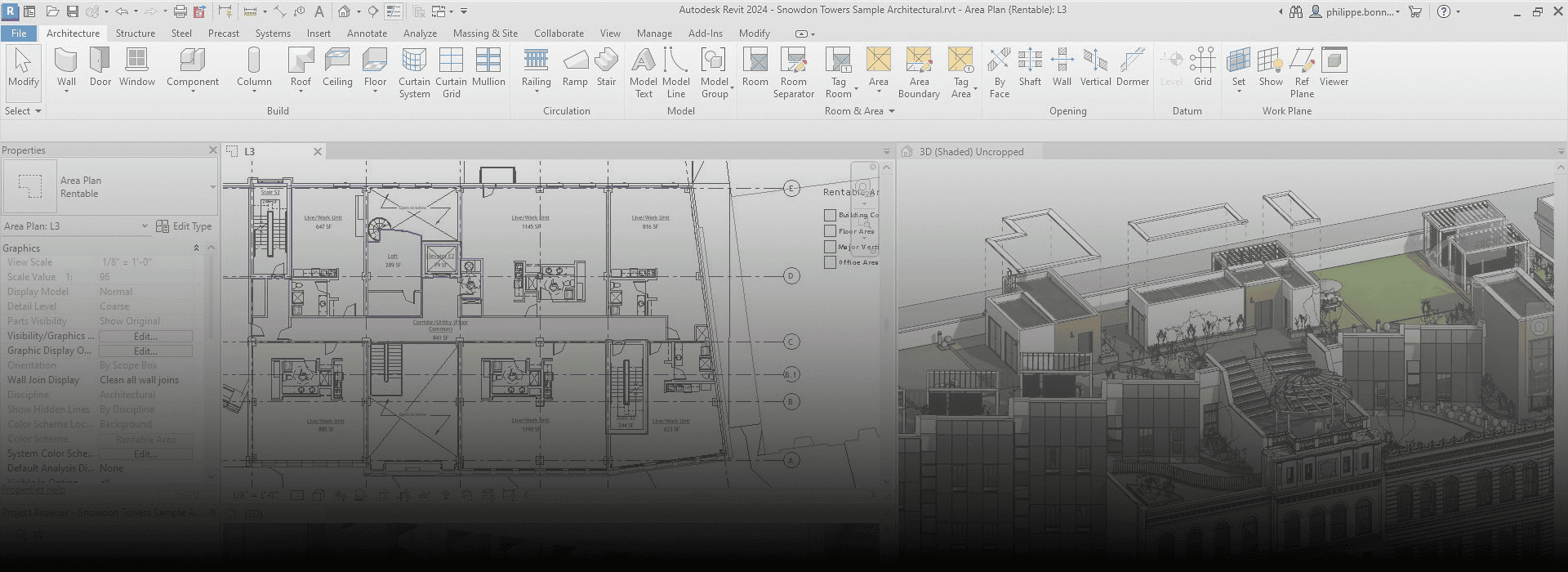
What is Revit Architecture ?
Revit Architecture is a design and documentation software specifically for architects, civil engineers, and building designers. It enables users to design buildings and structures in 3D, annotate the model with 2D drafting elements, and access building information from the model’s database.
Uses and Purposes of Revit Architecture
- 3D Architectural Design
- Create detailed 3D models of residential, commercial, or industrial buildings.
- Building Information Modeling (BIM)
- Manage building components, details, and specifications in one unified model.
- Documentation
- Automatically generate floor plans, sections, elevations, schedules, and construction documents.
- Coordination and Collaboration
- Multiple stakeholders (architects, engineers, MEP, contractors) can work on the same project simultaneously using cloud collaboration (e.g., Revit Cloud Worksharing).
- Visualization and Rendering
- Produce realistic 3D renderings and walkthroughs for client presentations.
- Energy Analysis
- Integrate tools for sustainability and performance analysis (e.g., lighting, energy use).
Benefits and Advantages of Revit Architecture
Role | Typical Responsibilities |
| Structural BIM Modeler | Develop 3D models for structural components and detailing |
| Structural Draftsman | Prepare 2D/3D drawings, fabrication layouts, and schedules |
| BIM Coordinator (Structural) | Coordinate structural models with architectural and MEP models |
| Structural Engineer (Revit) | Design and analyze structures using Revit and linked analysis tools |
| BIM Technician | Support BIM execution plans and documentation |
| Revit Technician – Structures | Handle drafting, model updates, and coordination within structural discipline |
| Design Engineer (Structural BIM) | Design structural elements and ensure model accuracy and code compliance |
| Construction Document Specialist | Create construction-ready documents and shop drawings using BIM |
Revit Architecture empowers architects and engineers to build precise 3D models and detailed technical drawings up to 6D. Discover how our training at First Step Education in Kochi provides the flexibility and precision you need for modern, collaborative design.
How Revit Architecture Helps Engineering-Based Candidates
- Skill Enhancement: Provides knowledge of industry-standard BIM workflows.
- Career Readiness: Highly valued by AEC firms for project modeling and design.
- Interdisciplinary Use: Civil, structural, MEP, and architectural engineers use Revit for coordination.
- Project Portfolio: Enables creation of professional design portfolios to showcase skills.
- Industry-Relevant Practice: Increases employability in roles demanding BIM expertise.
Job Titles after Learning Revit Architecture
- BIM Modeler / BIM Coordinator
- Revit Technician / Revit Designer
- Architectural Designer
- Junior / Assistant Architect
- Civil CAD Engineer
- 3D Visualizer
- Draftsman (Architecture / Civil)
- Project Coordinator (AEC)
- Interior Designer (with BIM skills)