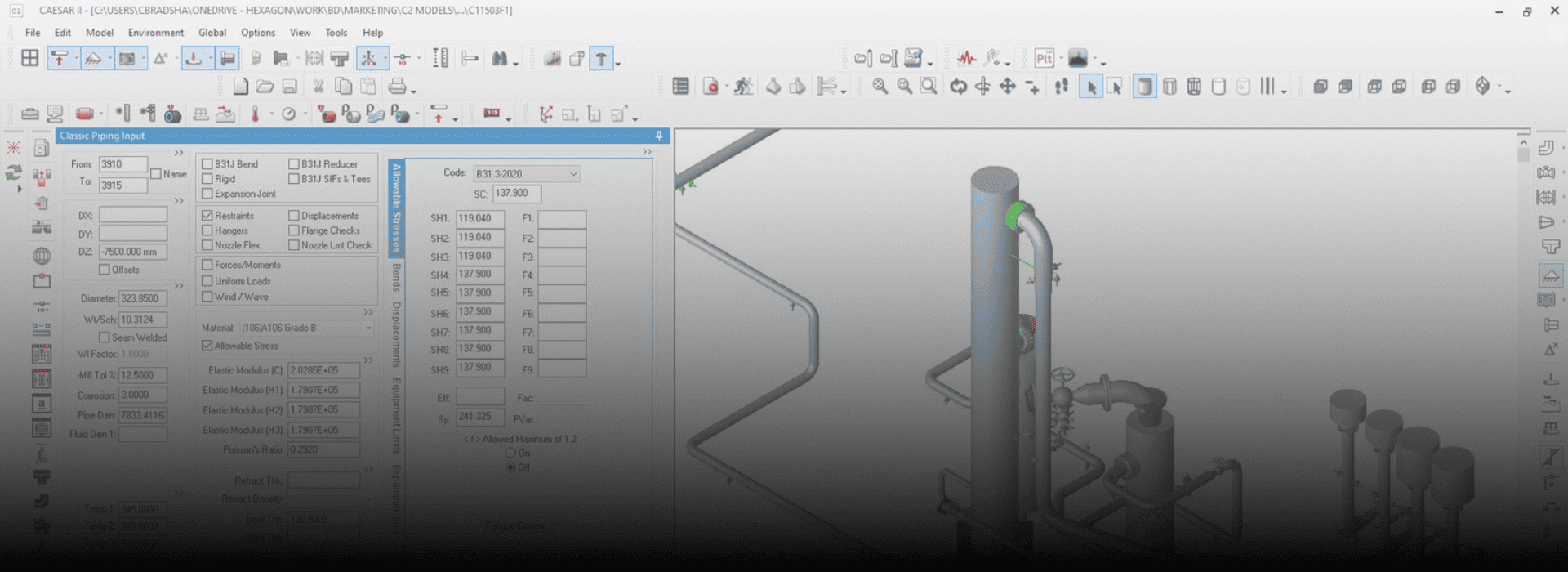
What is CAESAR II?
CAESAR II is a comprehensive software tool used for piping stress analysis and pipe design. It is developed by Intergraph (now part of Hexagon) and is widely used in industries like oil and gas, petrochemical, power generation, and other industries where piping systems are integral to the design and operation.
CAESAR II helps engineers and designers perform detailed static and dynamic analysis of piping systems, assessing stresses, deformations, and reactions due to temperature changes, pressure, and external loads.
Static Analysis vs Dynamic Analysis in CAESAR II
Aspect | Static Analysis | Dynamic Analysis |
| Definition | Analysis under constant or steady-state loads | Analysis under time-varying or fluctuating loads |
| Load Types | - Weight of pipe and contents - Internal pressure - Thermal expansion/contraction - Wind or snow loads | - Seismic (earthquake) - Water hammer - Equipment vibrations - Pressure surges |
| Purpose | To check stress, displacement, and support loads under normal conditions | To evaluate the system's behavior during transient or sudden events |
| Results Provided | - Stresses - Displacements - Loads on supports | - Natural frequencies - Mode shapes - Time-history response |
| Complexity | Relatively simpler and faster to perform | More complex; requires detailed input and understanding |
| When Used | For most general piping systems in design | For critical systems or where transient forces are expected |
| Analysis Types | - Sustained stress analysis -Thermal expansion analysis | - Modal analysis - Response spectrum - Time-history analysis |
| Typical Applications | - Standard plant piping - HVAC lines | - Long pipelines - Offshore piping - Gas transmission lines |
| Software Modules | Basic CAESAR II functionality | Requires CAESAR II Dynamic Module |
Uses and Purpose in the Oil and Gas Sector
- Accuracy and Reliability:
- CAESAR II allows engineers to perform highly accurate and detailed analysis of complex piping systems. This accuracy reduces the risk of failure and ensures safety and compliance with industry standards.
- Time-Saving and Efficiency:
- The software automates complex calculations and optimizes designs, saving time in the design and analysis phases. This results in faster project delivery and reduced costs.
- Comprehensive Load Analysis:
- It can handle a wide range of load cases like thermal, pressure, weight, seismic, and dynamic loads, allowing engineers to perform a comprehensive evaluation of a piping system’s response to various factors.
- Support for Codes and Standards:
- CAESAR II supports multiple international piping codes (e.g., ASME, DIN, and EN), making it easier to design systems that comply with regional and international regulatory requirements.
- Integration with Other Engineering Software:
- CAESAR II integrates well with other design software like AutoCAD Plant 3D, AVEVA Everything3D(E3D),SmartPlant 3D/Smart 3D (SP3D/S3D),CADWorx, allowing seamless data exchange between design and stress analysis tools.
- Flexibility in Modeling:
- The software provides flexibility in modeling complex piping systems, including valves, fittings, and equipment, and can handle both 2D and 3D pipe layouts.
- Reporting and Documentation:
- CAESAR II generates detailed, customizable reports that make it easy for engineers to share findings and analysis with other stakeholders or regulatory bodies.
- User-Friendly Interface:
- It features a graphical interface that simplifies the process of setting up models and viewing results, making it easier for engineers at all levels to use.
How CAESAR II Helps Engineering Candidates who are interested in Piping Design?
- Skills Development:
- Learning CAESAR II equips engineers with essential stress analysis skills, helping them understand the behavior of piping systems under different loads and conditions.
- It enhances their ability to design robust and safe piping systems, making them valuable assets to organizations in the oil and gas sector.
- Industry-Relevant Knowledge:
Since CAESAR II is a widely used software in the oil and gas industry, expertise in it gives candidates a strong competitive edge when applying for jobs in piping engineering and design.
- Hands-On Experience:
- Candidates get hands-on experience in analyzing real-world scenarios involving temperature fluctuations, pressure changes, and mechanical stresses on pipelines, which is a key part of engineering projects.
- Improved Employability:
Proficiency in CAESAR II opens doors for various piping design roles, especially since many companies prioritize candidates with experience using industry-standard software tools for stress analysis.
Job Titles After Learning CAESAR II
- Piping Stress Engineer
- Piping Design Engineer
- Piping Engineer
- Mechanical Engineer (Piping Focus)
- Stress Analysis Engineer
- Senior Piping Engineer
- Piping Stress Analyst