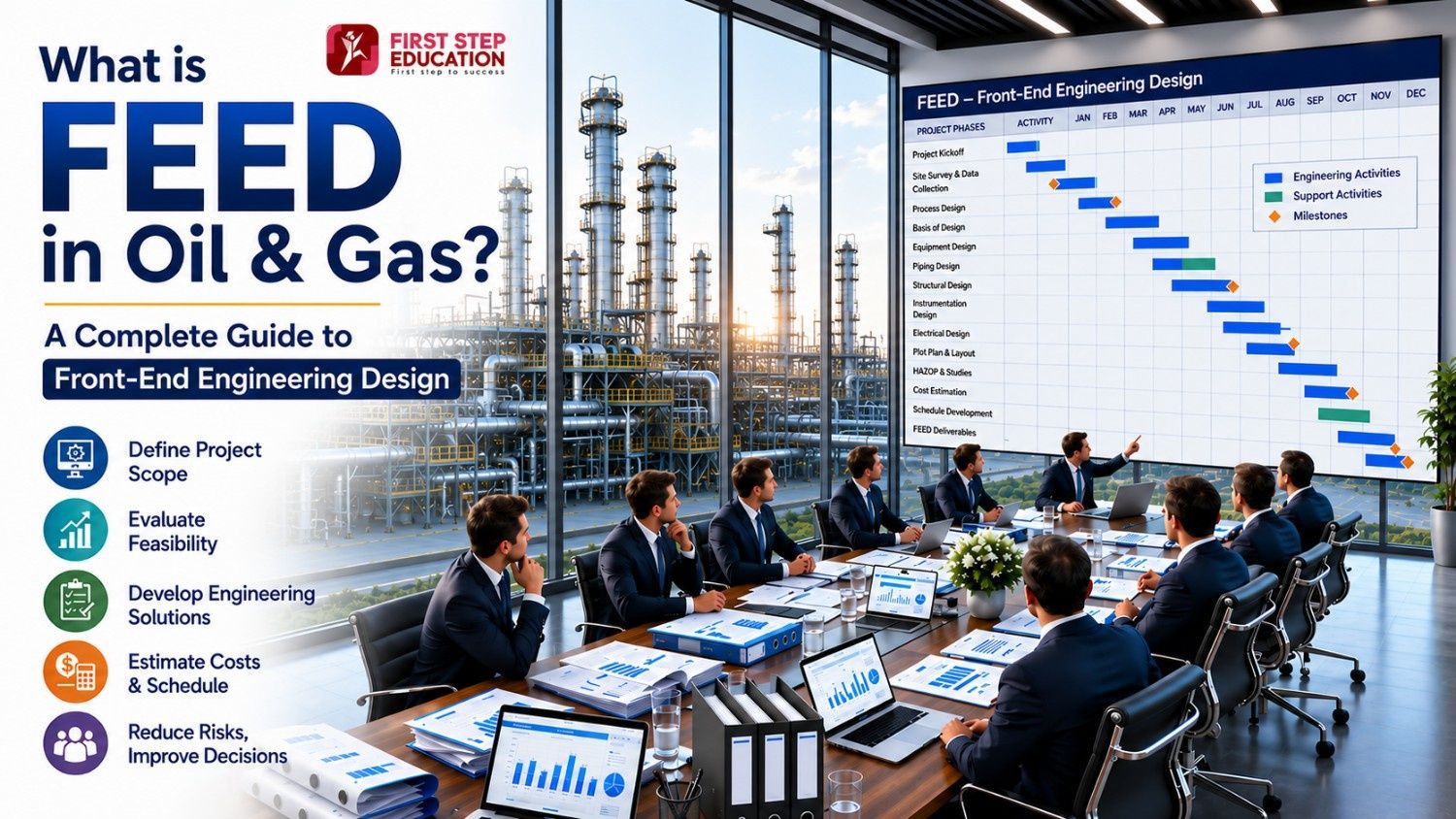
What is FEED in Oil & Gas? A Complete Guide to Front-End Engineering Design
Introduction
Large oil and gas facilities such as refineries, offshore platforms, LNG terminals, petrochemical plants, and pipeline networks involve investments ranging from millions to billions of dollars. Before construction begins, every aspect of the project must be carefully planned to minimize risks, optimize costs, and ensure technical feasibility.
This critical planning phase is known as Front-End Engineering Design (FEED).
FEED serves as the bridge between conceptual engineering and detailed engineering. It transforms an initial project idea into a well-defined engineering package that provides sufficient technical and commercial information for project owners to make Final Investment Decisions (FID), invite EPC contractors for bidding, and execute the project with confidence.
Without a well-executed FEED, projects are far more likely to experience cost overruns, schedule delays, design changes, procurement issues, and construction challenges.
What Does FEED Stand For?
FEED stands for Front-End Engineering Design.
It is the engineering phase where a project's major technical decisions are finalized before detailed engineering begins.
During FEED, engineers determine:
- How the plant will operate
- What equipment will be installed
- How piping systems will be routed
- Utility requirements
- Safety philosophy
- Process parameters
- Construction strategy
- Estimated project cost
- Project schedule
At the end of FEED, approximately 20–40% of the engineering design is completed, providing enough information to accurately estimate project costs and prepare EPC tender documents.
Why is FEED Important?
Imagine building a house without finalizing the architectural drawings. Changes made during construction would dramatically increase costs and delay completion.
The same principle applies to oil and gas facilities.
FEED helps project owners answer critical questions such as:
- Is the project technically feasible?
- Is it economically viable?
- Can the plant operate safely?
- What environmental regulations must be satisfied?
- How much will construction cost?
- How long will the project take?
- Which equipment should be selected?
- What are the project risks?
Because most major engineering decisions are made during FEED, this phase has a significant impact on the project's total lifecycle cost.
Objectives of FEED
The primary objectives of Front-End Engineering Design include:
- Develop a technically feasible plant design
- Reduce engineering uncertainty
- Improve cost estimate accuracy
- Minimize project risks
- Optimize plant performance
- Support Final Investment Decision (FID)
- Prepare EPC tender packages
- Define project execution strategy
- Ensure compliance with industry standards
- Improve constructability and operability
Typical FEED Workflow
A typical FEED study follows a structured engineering workflow.
1. Project Definition
The project owner defines the business objectives.
Typical inputs include:
- Production capacity
- Feedstock information
- Product specifications
- Site location
- Applicable regulations
- Budget constraints
Example:
A refinery plans to increase diesel production by installing a new hydrotreater unit.
2. Process Engineering
Process engineers develop the overall process concept.
Major activities include:
- Process simulation
- Material balance
- Heat balance
- Utility calculations
- Equipment sizing
- Process optimization
Deliverables include:
- Process Flow Diagrams (PFD)
- Heat & Material Balance
- Utility Summary
- Equipment List
3. Process Safety Studies
Safety becomes a major focus during FEED.
Typical studies include:
- HAZID
- HAZOP
- SIL Assessment
- Fire & Gas Philosophy
- Relief System Design
- Hazardous Area Classification
- QRA (where applicable)
These studies help identify hazards before construction begins.
4. Mechanical Engineering
Mechanical engineers define major equipment requirements.
Typical equipment includes:
- Pressure vessels
- Heat exchangers
- Storage tanks
- Pumps
- Compressors
- Reactors
- Columns
- Air coolers
Deliverables include:
- Equipment datasheets
- Mechanical specifications
- Preliminary GA Drawings
- Equipment layouts
5. Piping Engineering
Piping engineering begins once equipment locations are finalized.
Typical FEED activities include:
- Plot plans
- Equipment arrangement
- Preliminary piping routing
- Line sizing
- Pipe specifications
- Valve selection
- Pipe supports
- Preliminary isometrics
Deliverables:
- Plot Plan
- Piping Layout
- Line List
- Piping Material Specification
- Valve Datasheets
6. Piping Stress Engineering
Stress engineers evaluate piping flexibility.
Major tasks include:
- Thermal expansion analysis
- Nozzle load verification
- Support location studies
- Expansion loop design
- Dynamic analysis (where required)
Software commonly used:
- CAESAR II
- AutoPIPE
- START-PROF
7. Civil & Structural Engineering
Civil engineers prepare:
- Site grading
- Foundation concepts
- Underground routing
- Structural steel concepts
- Pipe rack design philosophy
Deliverables include:
- Foundation layout
- Structural framing
- Preliminary calculations
8. Electrical Engineering
Electrical engineers estimate plant power requirements.
Activities include:
- Load list
- Power distribution
- Substation layout
- Cable philosophy
- Emergency power system
- Earthing concept
- Lighting design
9. Instrumentation & Control
Instrumentation engineers define plant automation.
Deliverables:
- Instrument Index
- Instrument Datasheets
- Cause & Effect Matrix
- Control Philosophy
- I/O List
- Instrument Hook-ups
- Preliminary DCS Architecture
10. Procurement Planning
Procurement specialists identify:
- Long-lead equipment
- Vendor requirements
- Material procurement strategy
- Technical bid evaluation criteria
11. Cost Estimation
One of FEED's most important outcomes is preparing an accurate project estimate.
Typical FEED cost accuracy: ±10–15%
This is much more reliable than estimates prepared during conceptual studies.
12. Project Execution Planning
The engineering team develops:
- Construction sequence
- Project schedule
- Risk register
- Contract strategy
- EPC package definition
Major FEED Deliverables
A comprehensive FEED package may include:
Process Documents
- Process Design Basis
- Process Flow Diagram (PFD)
- Piping & Instrumentation Diagram (P&ID)
- Utility Balance
- Process Calculations
Mechanical Documents
- Equipment Datasheets
- Equipment Specifications
- Equipment List
Piping Documents
- Plot Plan
- General Arrangement Drawings
- Line List
- Pipe Specifications
- Valve List
- Material Specifications
Stress Analysis
- Stress Design Basis
- Preliminary Stress Reports
- Support Philosophy
Civil Documents
- Site Layout
- Foundation Concepts
- Structural Drawings
Electrical Documents
- Single Line Diagram
- Load List
- Cable Philosophy
- Electrical Specifications
Instrumentation
- Instrument Index
- Control Philosophy
- Instrument Datasheets
Safety Documents
- HAZOP Report
- Fire Protection Philosophy
- Safety Design Basis
Commercial Documents
- Cost Estimate
- EPC Tender Package
- Procurement Plan
- Project Schedule
Engineering Disciplines Involved in FEED
A successful FEED project requires collaboration among multiple engineering disciplines.
These typically include:
- Process Engineering
- Mechanical Engineering
- Piping Engineering
- Piping Stress Engineering
- Civil Engineering
- Structural Engineering
- Electrical Engineering
- Instrumentation & Control
- Process Safety Engineering
- Materials Engineering
- Corrosion Engineering
- HVAC Engineering
- Procurement Engineering
- Project Controls
- Construction Planning
- Commissioning Engineering
FEED vs Detailed Engineering
Although FEED and Detailed Engineering are closely related, they serve different purposes.
FEED | Detailed Engineering |
|---|---|
| Defines the engineering concept | Produces construction-ready documents |
| Focuses on project feasibility | Focuses on execution |
| Equipment selection | Fabrication drawings |
| Preliminary layouts | Final layouts |
| Preliminary stress studies | Final stress analysis |
| Budget estimate | Procurement quantities |
| Tender documentation | IFC (Issued for Construction) drawings |
Simply put, FEED answers "What should be built?", while Detailed Engineering answers "How exactly will it be built?"
FEED in Different Oil & Gas Sectors
FEED is used across nearly every segment of the energy industry.
Upstream
- Offshore platforms
- Onshore production facilities
- Gas gathering stations
- Wellhead facilities
Midstream
- Pipelines
- Compressor stations
- Pumping stations
- LNG export terminals
Downstream
- Refineries
- Petrochemical plants
- Fertilizer plants
- Gas processing plants
- Storage terminals
Benefits of a High-Quality FEED
A well-developed FEED package offers significant advantages:
- Reduces engineering changes during construction
- Improves cost predictability
- Shortens project schedules
- Enhances plant safety
- Optimizes equipment selection
- Simplifies procurement
- Improves constructability
- Minimizes project risks
- Supports regulatory approvals
- Enables competitive EPC bidding
Industry experience consistently shows that investing more effort during FEED often results in lower overall project costs and fewer surprises during execution.
Common Challenges During FEED
Despite its importance, FEED can face several challenges, including:
- Incomplete project information
- Frequent changes in project scope
- Limited site data
- Vendor information delays
- Budget constraints
- Tight project schedules
- Coordination issues between engineering disciplines
- Evolving regulatory requirements
- Market fluctuations affecting equipment costs
Addressing these challenges early through effective planning, stakeholder communication, and multidisciplinary collaboration is key to a successful FEED outcome.
Best Practices for Successful FEED
Organizations that consistently deliver successful FEED projects typically follow these best practices:
- Clearly define project scope before engineering begins.
- Involve all engineering disciplines from the early stages.
- Perform comprehensive process safety reviews.
- Engage equipment vendors for critical packages early.
- Conduct regular design review meetings.
- Maintain rigorous document control and revision management.
- Perform value engineering to optimize cost and performance.
- Validate constructability and maintainability throughout the design.
- Develop realistic schedules and cost estimates.
- Ensure alignment between engineering, procurement, construction, and operations teams.
Future Trends in FEED
The FEED process is evolving rapidly with advancements in digital engineering and automation. Emerging trends include:
- Digital twins for design validation
- Cloud-based multidisciplinary collaboration
- Building Information Modeling (BIM)
- Artificial Intelligence for design optimization
- Automated clash detection
- Integrated 3D plant modeling
- Advanced process simulation
- Data-driven risk assessment
- Sustainable and low-carbon facility design
These technologies enable engineering teams to improve design quality, reduce project risks, and accelerate project execution.
Conclusion
Front-End Engineering Design (FEED) is one of the most important phases of any oil and gas project. It establishes the technical foundation upon which every subsequent stage—from detailed engineering and procurement to construction and commissioning—is built.
A comprehensive FEED package reduces uncertainty, improves cost accuracy, enhances safety, and supports informed investment decisions. Whether the project involves a refinery, LNG terminal, offshore platform, pipeline, or petrochemical complex, the quality of the FEED study often determines the overall success of the project.
For engineers, project managers, EPC contractors, and asset owners alike, understanding FEED is essential. Investing time and resources in this early engineering phase leads to more efficient execution, fewer costly changes during construction, and facilities that are safer, more reliable, and better optimized throughout their operational life.