The Complete Lifecycle Of An Oil & Gas Project: From Concept to Closure And Beyond PART 3
How the Engineering Disciplines Work Together
One of the most important lessons from the oil & gas project life cycle is that no engineering discipline works in isolation.
Consider a simple example.
A process engineer changes the operating temperature of a process line.
That change can affect:
Process Engineering → operating conditions
Piping Engineering → pipe specification and routing
Stress Engineering → thermal expansion and flexibility
Mechanical Engineering → equipment design conditions
Materials Engineering → material selection
Civil/Structural → support loads
Instrumentation → measurement and control requirements
Safety Engineering → relief and safeguarding requirements
This is why multidisciplinary coordination is essential throughout the project.
The Importance of Project Controls
Technical engineering is only one part of successful project execution.
Large oil & gas projects also require strong project controls.
Project controls typically monitor:
- Cost
- Schedule
- Progress
- Resources
- Procurement
- Engineering deliverables
- Construction progress
- Risks
- Changes
Cost control
Project teams continuously compare:
Budget vs. Actual Cost
Schedule control
Teams monitor:
Planned Progress vs. Actual Progress
Change management
Changes are inevitable in complex projects. However, uncontrolled changes can lead to major cost and schedule impacts.
Therefore, changes are normally managed through a formal change-control process.
HSE Throughout the Entire Life Cycle
Health, Safety and Environment—commonly referred to as HSE—is not a single project phase.
It applies throughout the entire life cycle.
HSE considerations begin during concept development and continue through:
- Engineering
- Procurement
- Construction
- Commissioning
- Operations
- Maintenance
- Decommissioning
Examples include:
- Process safety
- Fire protection
- Hazardous area classification
- Emergency shutdown systems
- Gas detection
- Environmental protection
- Occupational safety
- Waste management
- Emergency response
A technically excellent facility is not considered successful if it cannot be operated safely.
Digital Engineering Across the Project Life Cycle
Modern oil & gas projects increasingly use digital engineering technologies.
These may include:
- 3D plant modelling
- Digital twins
- Building Information Modelling (BIM)
- Laser scanning
- Cloud-based document management
- Engineering databases
- Automated design checking
- Computational Fluid Dynamics (CFD)
- Finite Element Analysis (FEA)
- Digital project controls
- Advanced simulation
For example, a 3D model can help engineers identify clashes between:
- Piping
- Structural steel
- Equipment
- Cable trays
- HVAC
- Instrumentation
before construction begins.
This can reduce rework and improve constructability.
Key Decision Gates in an Oil & Gas Project
Large projects typically have formal decision points or stage gates.
At each gate, management evaluates whether the project should:
- Continue
- Be modified
- Be delayed
- Be re-evaluated
- Be cancelled
Typical decisions may include:
Gate 1: Is the opportunity worth investigating?
Gate 2: Is the selected concept technically and economically feasible?
Gate 3: Is the project sufficiently defined to authorize major expenditure?
Gate 4: Is the engineering mature enough for procurement and construction?
Gate 5: Is the facility ready for start-up?
These gates help prevent organizations from committing large amounts of capital before sufficient information is available.
Why the Early Stages Matter So Much
One of the most important principles in oil & gas project execution is:
The cost of making a change increases as the project progresses.
Changing an idea during concept development may require only a revised study.
Changing the same decision during FEED may require significant engineering work.
Changing it after equipment has been ordered may result in:
- Cancellation costs
- Re-design
- Re-fabrication
- Procurement delays
Changing it during construction may result in:
- Demolition
- Rework
- Construction delays
- Additional manpower
- Safety risks
- Significant cost increases
This is why companies invest heavily in front-end planning and engineering.
Good early decisions can prevent expensive problems later.
What Makes an Oil & Gas Project Successful?
A successful project is not simply one that finishes construction.
A successful project should deliver:
Safety
The facility can be constructed and operated safely.
Quality
Engineering, equipment, materials, and construction meet required standards.
Cost
The project remains within an acceptable financial range.
Schedule
The facility is delivered within the required timeframe.
Operability
Operators can operate the facility safely and efficiently.
Reliability
Equipment and systems perform as intended.
Maintainability
Equipment can be inspected, maintained, and repaired effectively.
Environmental Performance
The facility complies with environmental requirements and minimizes its impact.
Commercial Value
The completed asset delivers the expected business value.
Conclusion
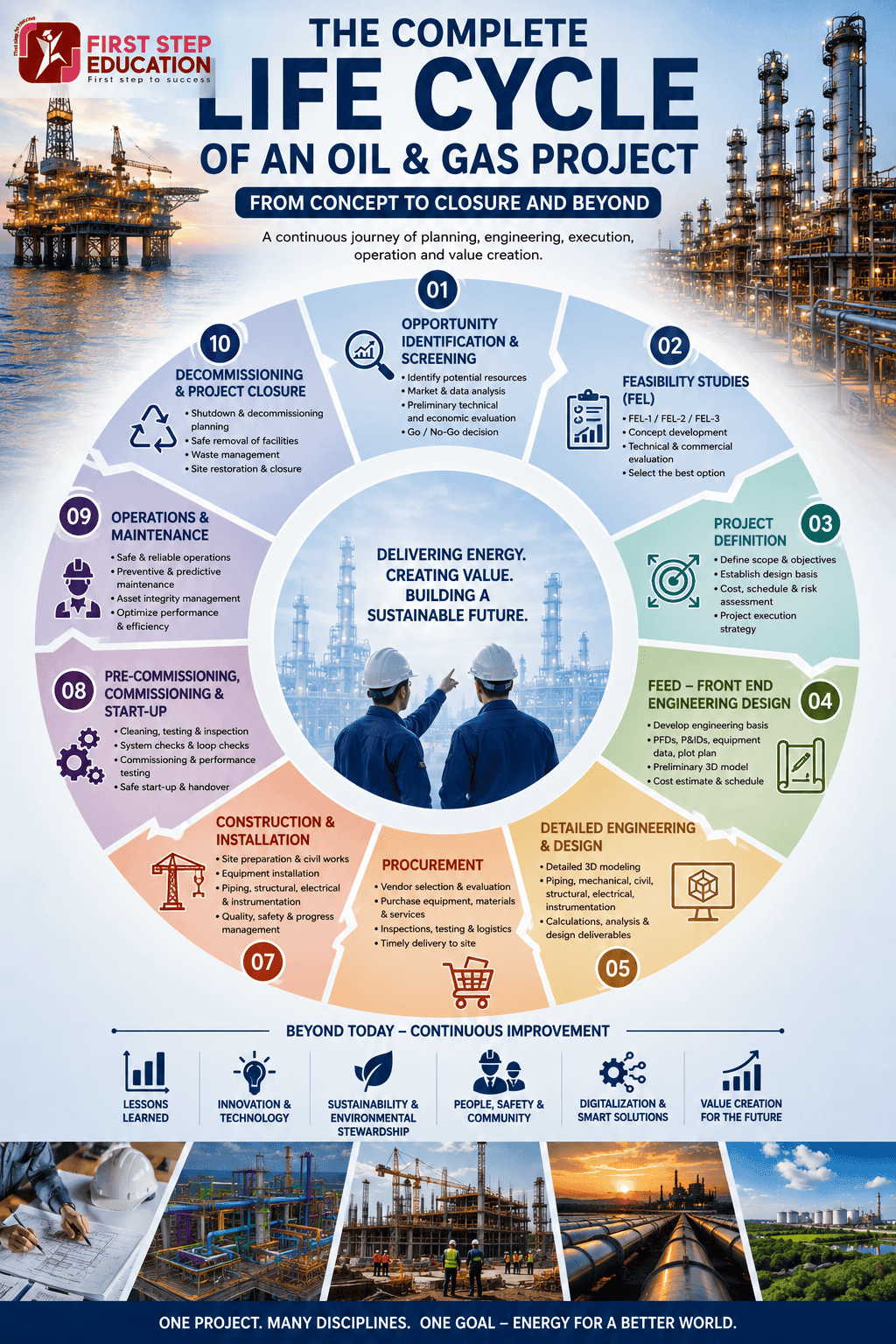
The life cycle of an oil & gas project is a long and interconnected journey. It starts with an opportunity and progresses through feasibility, concept development, FEED, detailed engineering, procurement, construction, commissioning, operations, and eventually decommissioning.
Every stage depends on the quality of the work performed in the stages before it.
A poor concept can create problems during FEED.
Incomplete FEED can create problems during detailed engineering.
Incomplete engineering can create procurement and construction problems.
Poor construction can create commissioning problems.
And inadequate commissioning or maintenance can affect the long-term reliability and safety of the facility.
For engineers and students entering the oil & gas industry, understanding this complete life cycle provides an important perspective: engineering is not just about producing drawings or calculations. It is about creating an asset that can be safely constructed, commissioned, operated, maintained, modified, and eventually retired.
From the first business idea to the final site restoration, every discipline contributes to the project's success.
The complete oil & gas project life cycle can therefore be viewed as one continuous engineering and business journey—where planning, design, execution, operation, and learning are connected at every stage.