The Complete Lifecycle Of An Oil & Gas Project: From Concept to Closure And Beyond - PART 1
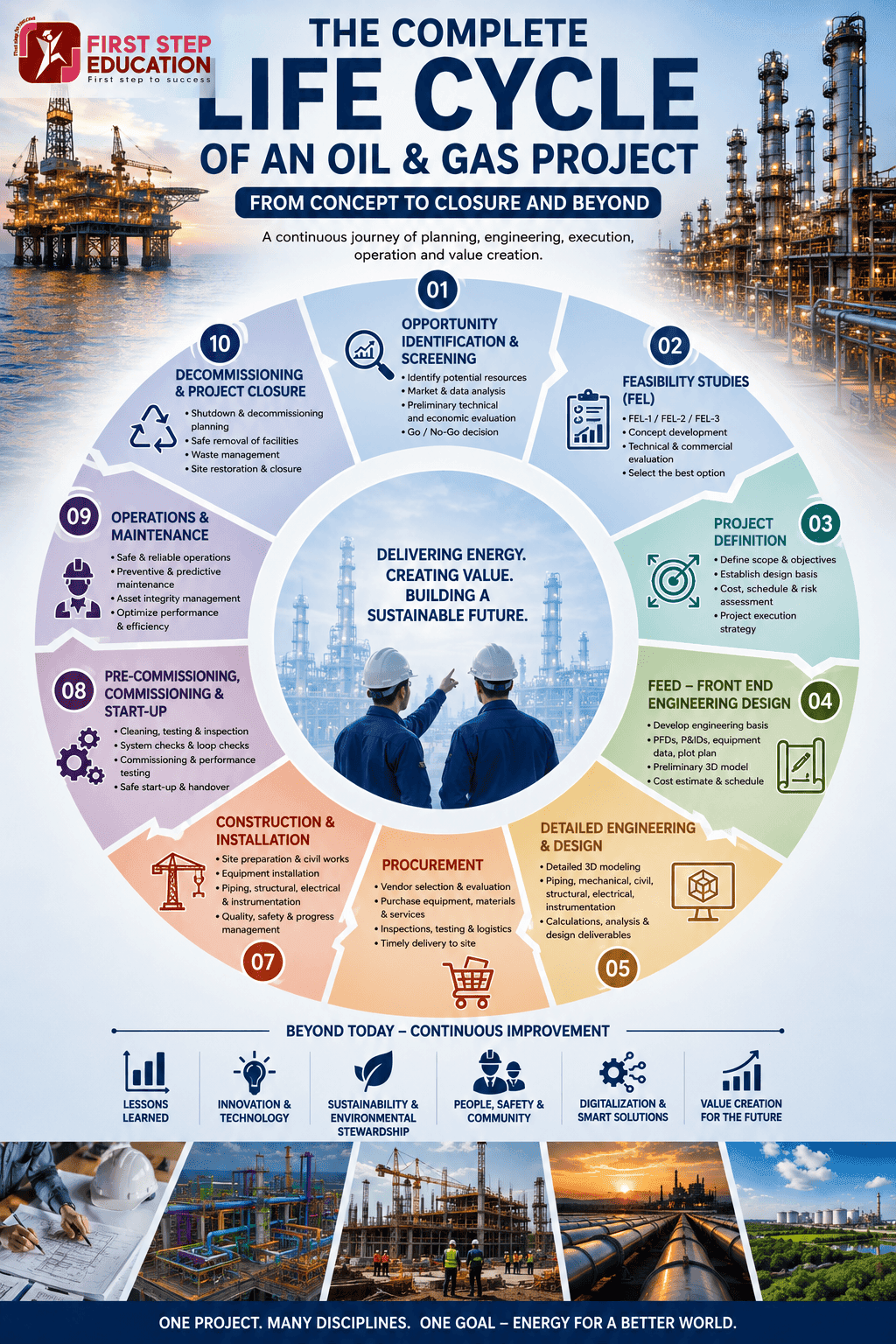
Oil & gas projects are among the most complex and capital-intensive projects in the world. Whether the project involves developing an offshore oil field, constructing a gas processing facility, expanding a refinery, building a pipeline network, or developing an LNG facility, successful delivery requires the coordinated effort of many engineering disciplines, contractors, suppliers, operators, regulators, and other stakeholders.
Unlike a simple construction project, an oil & gas project can take several years from the initial idea to commercial operation. Decisions made during the early stages can have a significant impact on project cost, schedule, safety, operability, and long-term profitability.
Understanding the complete life cycle of an oil & gas project helps engineers, students, project managers, designers, and other industry professionals understand how a project progresses from an initial opportunity into a functioning facility and eventually reaches decommissioning and closure.
What Is the Life Cycle of an Oil & Gas Project?
The project life cycle is the sequence of stages through which an oil & gas project passes, from the identification of an opportunity through planning, engineering, procurement, construction, commissioning, operation, and eventual decommissioning.
Although the terminology can vary between companies and project types, a typical oil & gas project can be divided into the following major phases:
- Opportunity Identification and Screening
- Feasibility Studies / Front-End Loading (FEL)
- Project Definition
- FEED – Front-End Engineering Design
- Detailed Engineering and Design
- Procurement
- Construction and Installation
- Pre-Commissioning, Commissioning and Start-up
- Operations and Maintenance
- Decommissioning and Project Closure
Some organizations combine or rename these stages. For example, project definition and FEED may be grouped under front-end engineering, while engineering, procurement and construction may be managed together under an EPC contract.
The important point is that the project does not begin with construction. A large amount of technical and commercial work takes place before the first piece of equipment is fabricated or installed.
1. Opportunity Identification and Initial Screening
Every oil & gas project begins with an opportunity.
The opportunity may arise from several sources:
- Discovery of a new oil or gas field
- Expansion of an existing production facility
- Increasing market demand
- Refinery capacity expansion
- Development of a new gas processing facility
- LNG development
- Pipeline or terminal requirements
- Replacement of aging infrastructure
- Process debottlenecking
- Energy-transition or emissions-reduction requirements
At this stage, the project is still an idea rather than a fully developed engineering project.
Key activities
The project team may perform:
- Preliminary market studies
- Reservoir and exploration data review
- Initial production estimates
- Site/location screening
- Technology screening
- Preliminary process studies
- Initial infrastructure assessment
- Environmental and regulatory screening
- Preliminary risk assessment
- High-level capital cost estimation
- Initial economic evaluation
The objective is to answer a fundamental question:
“Is this opportunity technically feasible and commercially worth pursuing?“
Typical outcome
The organization may make a preliminary Go / No-Go decision.
If the opportunity appears attractive, the project progresses to more detailed studies.
2. Feasibility Studies and Front-End Loading (FEL)
Once an opportunity passes the initial screening stage, the project enters a more detailed evaluation phase.
This phase is often referred to as Front-End Loading (FEL) or Front-End Development, depending on the organization.
The purpose of front-end work is to reduce uncertainty before significant capital is committed.
A typical FEL approach may be divided into:
- FEL-1 – Opportunity assessment
- FEL-2 – Concept selection
- FEL-3 – Definition and project planning
The exact terminology varies between organizations.
What happens during feasibility?
Engineers and project teams evaluate different development options.
For example, a gas field may have several possible development concepts:
- Onshore processing
- Offshore processing
- Subsea development
- Pipeline transportation
- LNG development
- Tie-in to an existing facility
Each option is compared based on:
- Capital expenditure
- Operating expenditure
- Production capacity
- Technical complexity
- Schedule
- Safety
- Environmental impact
- Reliability
- Operability
- Commercial return
Technical studies
Depending on the project, studies may include:
- Reservoir studies
- Geotechnical studies
- Metocean studies
- Process simulations
- Pipeline studies
- Hydraulic studies
- Electrical studies
- Equipment studies
- Environmental studies
- HAZID studies
- Preliminary HAZOP activities
- Utility studies
- Logistics studies
Economic evaluation
The project team also develops increasingly reliable estimates of:
- CAPEX – Capital Expenditure
- OPEX – Operating Expenditure
- Production revenue
- Project schedule
- Cash flow
- Payback
- Economic return
- Financial risks
The objective is to identify the best overall development concept, rather than simply selecting the cheapest option.
3. Project Definition
After feasibility and concept selection, the project moves into a more clearly defined stage.
At this point, the owner begins establishing exactly what the project is expected to deliver.
The project scope may define:
- Production capacity
- Processing capacity
- Product specifications
- Facility location
- Battery limits
- Feedstock characteristics
- Design life
- Applicable codes and standards
- Environmental requirements
- Safety requirements
- Project schedule
- Cost targets
- Reliability requirements
A Basis of Design is typically developed to establish the fundamental engineering assumptions and criteria.
Why project definition matters
Poorly defined projects can experience:
- Scope changes
- Cost overruns
- Schedule delays
- Engineering rework
- Procurement problems
- Construction difficulties
- Commissioning issues
A well-defined project creates a strong foundation for the engineering and execution phases.
4. FEED – Front-End Engineering Design
FEED is one of the most important stages in the oil & gas project life cycle.
FEED converts the selected project concept into a sufficiently developed engineering design that can be used to establish project scope, cost, schedule, risk, and execution strategy.
During FEED, engineers from multiple disciplines work together.
Major FEED disciplines
These can include:
- Process Engineering
- Piping Engineering
- Mechanical Engineering
- Civil & Structural Engineering
- Electrical Engineering
- Instrumentation & Control
- Pipeline Engineering
- Process Safety
- Materials Engineering
- HVAC
- Telecom
- Fire & Gas
- Environmental Engineering
- HSE
Typical FEED deliverables
Depending on project scope, FEED may include:
- Process Flow Diagrams (PFDs)
- Piping & Instrumentation Diagrams (P&IDs)
- Equipment lists
- Equipment datasheets
- Line lists
- Preliminary piping layouts
- Plot plans
- Utility summaries
- Heat and material balances
- Preliminary equipment sizing
- Preliminary material selection
- Electrical load lists
- Instrument indexes
- Control philosophy
- Safety studies
- Preliminary 3D model
- Civil design criteria
- Structural design criteria
- Cost estimate
- Project execution plan
FEED also provides the basis for preparing tender packages and selecting the appropriate EPC execution strategy.
FEED and design engineering
FEED is particularly important for design engineers because it establishes many of the constraints within which detailed engineering must operate.
For example, a piping engineer may receive:
- P&IDs
- Equipment locations
- Design pressures and temperatures
- Line specifications
- Material specifications
- Piping classes
- Preliminary layouts
These become inputs for detailed piping design and stress analysis.
5. Detailed Engineering and Design
After FEED and project sanction, the project enters detailed engineering.
This is where the engineering team develops the design to a level suitable for procurement, fabrication, construction, testing, and commissioning.
This phase can involve thousands of engineering documents and drawings.
Process Engineering
Process engineers develop and finalize:
- Process simulations
- Heat and material balances
- PFDs
- P&IDs
- Equipment sizing
- Control philosophies
- Process datasheets
- Operating cases
- Relief system requirements
Piping Engineering
Piping engineering converts process requirements into a constructible piping system.
Typical activities include:
- Piping layout
- 3D modelling
- Pipe routing
- Piping material specification
- Isometric drawings
- Pipe support design
- Valve selection
- Stress analysis
- Flexibility analysis
- MTO generation
Piping stress engineers evaluate thermal expansion, sustained loads, occasional loads, equipment nozzle loads, support conditions, and other loading scenarios.
Mechanical Engineering
Mechanical engineers work on equipment such as:
- Pressure vessels
- Heat exchangers
- Pumps
- Compressors
- Tanks
- Separators
- Filters
- Package equipment
They prepare equipment specifications, datasheets, calculations, vendor requirements, and technical evaluations.
Civil and Structural Engineering
This discipline covers:
- Foundations
- Buildings
- Pipe racks
- Equipment supports
- Structural steel
- Platforms
- Access structures
- Roads and drainage
Electrical Engineering
Electrical engineers design:
- Power generation systems
- Substations
- Transformers
- Switchgear
- Motor systems
- Cable systems
- Earthing
- Lighting
- Emergency power
Instrumentation and Control
Instrumentation engineers develop:
- Instrument specifications
- Instrument indexes
- Control systems
- Safety instrumented systems
- Control valves
- Shutdown systems
- Alarm systems
- Fire and gas systems
Engineering coordination
One of the biggest challenges during detailed engineering is multidisciplinary coordination.
A process change can affect piping.
A piping change can affect structural steel.
A structural change can affect electrical routing.
A change in equipment size can affect foundations, piping, lifting arrangements, and access.
Therefore, engineering is not performed independently by each discipline. Continuous coordination is essential.
6. Procurement
Engineering defines what is required; procurement makes sure those requirements are obtained.
Oil & gas facilities contain a large number of materials and equipment, ranging from small valves and instruments to very large compressors and pressure vessels.
Procurement activities include:
- Preparation of material requisitions
- Request for quotation
- Vendor identification
- Technical bid evaluation
- Commercial evaluation
- Vendor selection
- Purchase order
- Vendor document review
- Manufacturing
- Inspection and testing
- Shipment
- Delivery to site
Long-lead items
Certain equipment can require months or even years to manufacture.
Examples include:
- Compressors
- Gas turbines
- Large pumps
- Pressure vessels
- Heat exchangers
- Electrical transformers
- Specialized valves
- Packaged systems
These are known as long-lead items.
Early identification and procurement of such equipment is critical to maintaining the project schedule.
Vendor engineering
Procurement is not simply buying equipment.
Vendors produce engineering documents such as:
- Drawings
- Datasheets
- Calculations
- Material certificates
- Inspection reports
- Operating manuals
- Maintenance manuals
These documents must be reviewed and incorporated into the overall project design.
"Continue reading the lifecycle execution phases in Part 2."